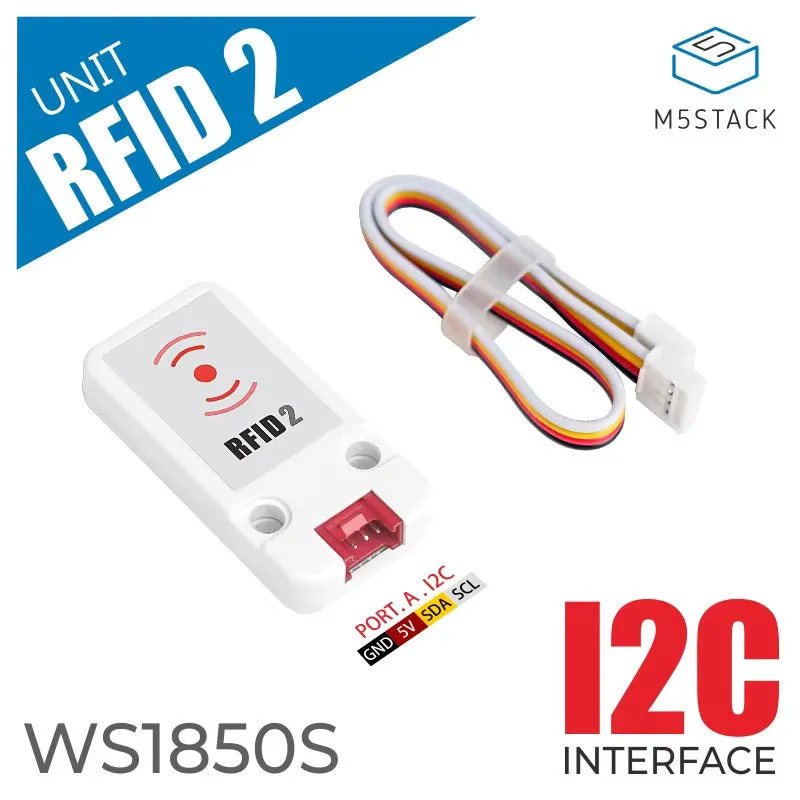
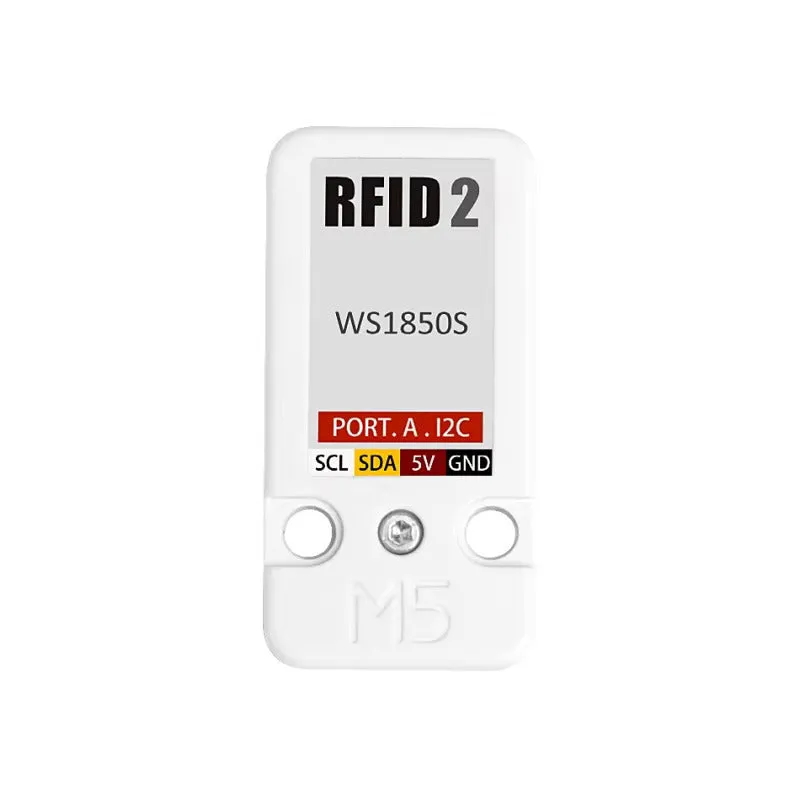
M5Stack RFID2 13.56MHz sensor module for Arduino and UIFlow IoT projects with 64-byte buffer, I2C interface, and 20mm reading distance


M5Stack RFID2 13.56MHz sensor module for Arduino and UIFlow IoT projects with 64-byte buffer, I2C interface, and 20mm reading distance
M5Stack RFID2 13.56MHz Sensor Module for Arduino and UIFlow IoT Applications

The M5Stack RFID2 sensor module provides 13.56MHz RFID functionality specifically designed for integration with microcontroller projects and IoT systems. With support for ISO14443A, MIFARE, and NTAG protocols, this compact module enables identification, authentication, and data exchange applications across industrial, educational, and prototyping environments. Its compatibility with popular development platforms including Arduino and UIFlow (through Blockly or Python) makes it accessible for both beginners and experienced developers looking to incorporate RFID technology into their projects without extensive hardware design.
Technical Specifications and Performance

This sensor module delivers core RFID functionality through carefully selected technical parameters that balance performance with practical application requirements across different environments and use cases.
Operating Frequency and Protocols
The module operates at the 13.56MHz frequency band, which is widely adopted for proximity RFID applications. It supports three major protocol standards: ISO14443A for general identification applications, MIFARE for secure access control and payment systems, and NTAG for NFC Forum-compatible tag operations. This protocol support allows integration with existing RFID infrastructure and provides flexibility for different application requirements without needing multiple specialized modules.
Communication Interface and Data Handling
Communication with host controllers occurs through the I2C interface, offering two speed modes: fast mode with data rates up to 400 kbit/s and high-speed mode supporting up to 3400 kbit/s. The module includes a 64-byte transceiver buffer for efficient data transfer between the RFID component and the host microcontroller, reducing processing overhead during read/write operations. Data storage capability exceeds 10 years, ensuring information retention for long-term applications.
Reading Distance and Power Characteristics
The sensor provides a reading distance under 20mm, suitable for close-proximity applications such as access control, inventory management, and device authentication. Power consumption varies between operational states, with an emission current specified at 240MHz during transmission and minimal sleep power consumption of just 1μA, making it suitable for battery-powered or energy-conscious applications where power management is important.
Development Platform Integration
The module is designed for straightforward integration with popular development ecosystems, reducing implementation time and technical barriers for developers working on IoT and automation projects across different experience levels.
Arduino Compatibility
Full compatibility with the Arduino ecosystem allows developers to use existing libraries and code examples to implement RFID functionality quickly. The module connects directly to Arduino boards through the I2C interface, requiring minimal additional components or circuit design. This compatibility extends across the Arduino product range, from basic Uno boards to more advanced MKR and Nano models, providing flexibility for different project requirements and constraints.
UIFlow Blockly and Python Support
Integration with UIFlow enables visual programming through Blockly or text-based programming with Python, making RFID functionality accessible without extensive coding experience. The visual programming approach through Blockly is particularly useful for educational settings, rapid prototyping, and applications where developers prefer a graphical programming interface. Python support provides additional flexibility for more complex implementations and integration with other Python-based systems.
Physical Prototyping and Mounting
Two Lego-compatible mounting holes enable easy integration into prototyping setups and custom enclosures without requiring specialized brackets or adapters. This physical design consideration supports rapid iteration during development phases and simplifies the transition from prototype to finished product. The compact 7x2 unit dimensions allow the module to fit into space-constrained applications while maintaining all necessary functionality.
Application Environments and Considerations

The module's technical specifications make it suitable for deployment across various environments, from controlled indoor settings to more demanding industrial applications, with specific characteristics supporting different implementation scenarios.
Temperature Range and Environmental Operation
With an operating temperature range from -20°C to 85°C, the module can function in environments that experience significant temperature variation, including outdoor applications, industrial settings, and automotive applications. This temperature tolerance ensures reliable operation across seasons and in locations without climate control, expanding potential use cases beyond typical indoor electronics applications.
IoT and Automation Implementation
The module serves as an identification component within broader IoT and automation systems, enabling objects, products, or assets to be uniquely identified and tracked through the production chain, inventory systems, or user interactions. Its compatibility with common IoT platforms and protocols allows seamless integration into existing infrastructure without requiring significant middleware development or protocol translation layers.
Practical Development Considerations
Programming the module with M5 devices requires specific baud rate settings depending on the controller used—750,000 or 115200 for M5StickC. Windows users can utilise EasyLoader for firmware updates, though CP210X drivers must be installed beforehand for M5Core controllers (not required for M5StickC). These specific requirements ensure proper communication during development while maintaining compatibility across the M5 product ecosystem.